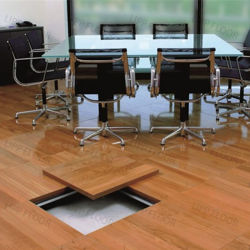
 Raised floor systems are applied in many different areas, especially in data centers. There is a standard method followed during the construction of raised floor systems. The stages of this process can be listed as follows:
Planning: In order for the raised floor systems to be implemented successfully, it is necessary to plan first. The area to be applied should be measured and the number of panels to be used should be determined by dividing it into 60×60 dimensions. In addition, if accessories such as steps, culverts and skirting boards will be used during the application, these should also be taken into account in the planning.
Floor Preparation: Since the raised floor systems are applied directly to the floor, the floor should be prepared for this process beforehand. If there is any roughness on the floor, it should be removed, and if it cannot be removed, it should be screed again. Situations that may prevent the feet that will carry the raised floor from sticking to the floor should also be eliminated. In addition, care should be taken to ensure that the floor is dry before the application.
Assembly: The final stage in the application of raised floor systems is the assembly stage. In the framework of the planning made in the first stage, the panels with the dimensions of 60×60 cm are placed on the carrier legs and fixed to the floor. In order to ensure that the assembly process is perfect, the method of leveling should also be applied during the work.
Where to use?
In its simplest form, raised floor systems can be defined as a second floor applied over the existing floor of the building. As there are technical reasons for applying these systems, they can also be applied for aesthetic purposes today. With the beginning to appeal to aesthetic purposes, very different models of these systems have emerged. The area between the main floor and the raised floor provides ample space for cables and other installation elements to pass through. These systems, which are extremely resistant to moisture and corrosion, can be used easily for many years. Raised floor systems are preferred in environments where it is necessary to combat moisture, especially in data centers, as it has a great effect on combating moisture on the ground. The interest in raised floor systems in hospitals and health centers, shopping malls, factories, commercial buildings and public institutions is increasing day by day.
The increasing need for raised floor products has expanded the usage areas of these products. Data centers are at the forefront of these usage areas. Data centers with cables with large load-bearing capacity are usually brought to ideal temperature values with sensitive air-conditioning methods. Passing these heat-emitting cables over the surface causes a decrease in the efficiency of air conditioning systems. For this reason, raised floor systems are used because it allows the cables to be carried under the ground and in a way that does not affect the environment.
Schools and educational institutions are among the areas where these systems are used intensively. In particular, carrying the system cables from the surface in such environments may cause both the cables to be damaged and the students to be harmed by this situation. The use of raised floors in hospitals and health centers is also extremely common. This application is of great importance in order to eliminate the bad appearance caused by the cables being carried from the surface and to perform air conditioning in sensitive environments such as the operating room.
In fact, the only purpose of use of these applications is not the transportation of cables. Due to their resistance to rust, raised floors are also used in the coating and protection of systems that are desired to be protected for a long time.
 Flooring Systems